

We now offer a wide selection of pre-owned vehicles!
Originally posted in the Wall Street Journal, Dan Neil 9/1/2022
The flagship luxury sedan from Genesis has the authority and totemic power of a chauffeur-driven long black car. We savors its lush, hushed ride.
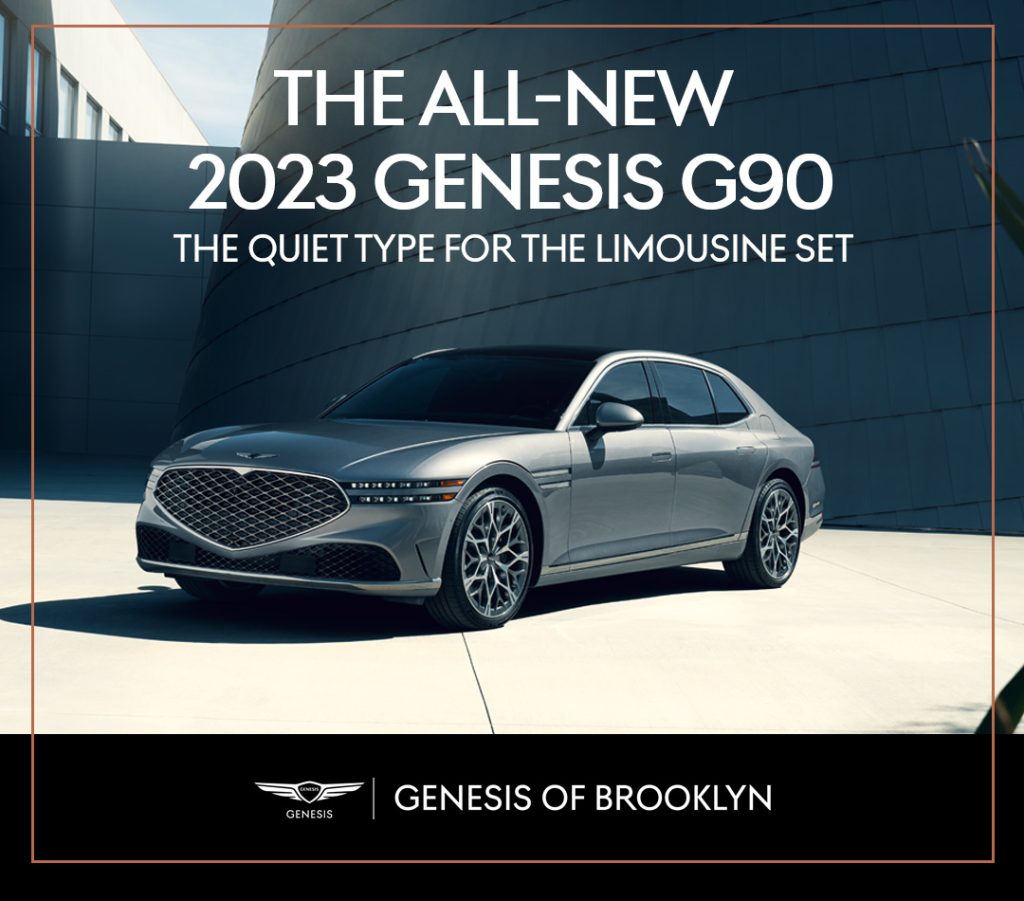
THE GLOBAL CAR INDUSTRY isn’t, really. North American-market pickups and SUVs find relatively few buyers elsewhere. There’s a slew of nifty little cars sold in Europe and Asia that are likewise unavailable stateside. Our guest this week—the well-drawn and lubricious 2023 Genesis G90 3.5T e-Supercharger—represents one of the few vehicle types embraced everywhere: the Long Black Car.
Ours was metallic midnight blue, but you get the idea.
Notionally, the new flagship from Genesis lines up against established LBC’s including Mercedes-Benz S-Class, BMW 7 Series and Audi A8, with the Porsche Panamera and Maserati Quattroporte thrown in for good measure. In the U.S. this segment accounts for about 50,000 sales annually, with prices between $100,000 to $250,000.
But the alignment is far from perfect. As a group and with varying degrees of passion, the European entrants privilege performance and driver involvement over passenger comfort, compromising the maximas of luxury and isolation to achieve magazine-blurb performance.
The G90 is all about the plush.
In its home market of South Korea, this car plays the role of personal limousine: a large status-forward luxury sedan, often privately owned, with a hired driver/body man in the left front seat. A more apt comparison than the Teutons would be the Toyota Century, a splendid grand piano of limousine only available in Japan. Both cars are portfolio pieces and objects of national industrial pride.
Our G90 drove pretty great, don’t get me wrong. Equipped with a twin-turbocharged 3.5-liter V6 dressed with electric supercharger (409 hp/405 lb-ft.), an eight-speed automatic and full-time all-wheel drive, the G90 is both respectably quick (4.7 seconds to 60 mph, estimates Car and Driver) and adequately fast (a CD-estimated 146 mph top speed).
The optional dynamic rear-wheel steering system allows the sleek five-meter sedan to round corners feeling smaller than it is, both at highway speeds and walking pace, while parking. The multi-link front suspension, including electric-assist rack-and-pinion steering, feels impressively stout yet lightly greased and easy to turn.
But what the G90 really does great is ride, um, great: the G90’s over-the-road serenity is ridiculous, downright ethereal. For that you could credit many things: the car’s hard-as-nails, heavy-as-sin steel structure; the long wheelbase; the active/predictive suspension with multichambered air springs. I don’t blame you if you dozed off.
The drive modes—Eco, Comfort and Sport—might as well be marked Serene, Stately and Swifter, for all the difference it makes to the car’s disposition. There is also a special extra-cush Chauffeur mode, to be used when the boss takes his Ambien. Real insomniacs should opt for the 20-inch tires, which would be quieter than the low-profile 21s.
In the rear, the two business-class reclining seats are 16-way adjustable/programmable, ventilated/heated, with “full massage function.” Yikes. Also included are a motorized footrest, motorized shades, three-zone climate control, and a selection of spritzed aromas. I like a hint of jasmine with my HR reports.
All the glass is acoustically laminated. The doors, engine compartment bulkhead (firewall) and voids between body panels are wadded with sound-attenuating materials aimed at various frequencies.
Other, more furtive radiations get swallowed up by the energetic noise-canceling audioware, which uses data from wheel sensors and cabin microphones to identify and produce the nulling frequencies. The loudest the G90 gets upshifting is a dull and distant mmm-mmm-mmm.
In furtherance of a solemn quiet, the G90’s engineers heaped on mass for its many delightful dampening effects. The G90’s power-assisted doors—springing open and closing softly at the touch of the proverbial button—feel like they weigh a ton apiece. Even with its modest 3.5-liter turbo V6, our G90 tipped the scales at almost 5,200 pounds.
If you cross shop our test car against likely competitors, you will quickly realize: (a) the G90’s metabolism is indeed slightly slower and softer than the average luxury Visigoth; (b) whatever performance deficits there might be are nearly irrelevant, being unobservable in the real world; and (c) OMG, I could save thousands. Look at all the standard equipment: all-wheel drive, mega-super-premium Bang & Olufsen audio system, the rear-cabin suite deluxe.
Even with big-ticket options like the air suspension and rear-wheel steering, our tester came in at $100,370, and was oh-so loaded: from limpid pools of high-resolution navigation, to quilted fields of Nappa leather upholstery, to its windows full of power shade. Or was that my neighbors?
It’s a beauty. These sorts of cars, built around large door openings, risk looking like recently fed anacondas, with a big lump in the middle. The G90’s silhouette and shoulder lines work together to give it a lovely taper. The shieldlike grille comprises two weave patterns of different colors, overlaid to create a 3-D effect. That works.
There are so many smart touches: the windshield-wiper trough concealed under the curving scuttle; the flush-fit glazing, brightwork and door handles; the near-absence of exterior cut lines, with panel gaps brilliantly camouflaged by the hood overslam and around the signature lighting at the front and rear fenders. If you were wondering where all the chrome went on luxury cars, I’ve found it.
One’s expectations of who gets out of an LBC depends on where you are. In Beverly Hills and Burbank, LBC’s are called studio cars, regardless of if any studio sent them. In Singapore, they are called hotel cars; in London, embassy cars.
The American market for private-use, chauffeur-driven large luxury sedans dropped off about the same time as did Lamont Cranston. Much of the remaining demand has been taken up by SUV-style vehicles, made by the usual luxury suspects.
These days, an LBC inevitably gives off the vibe of being on the job—a car with duties to perform, whether executive, diplomatic, formal or funereal. I’ve learned such cars exhibit a totemic power, a tacit civil authority, which at a minimum grants them preferred parking around clubs and restaurants.
But I would never.
Powertrain twin-turbocharged 3.5-liter DOHC V6 with 48-volt electric supercharger; eight-speed automatic transmission; full-time all-wheel drive
Power/torque: 409 hp @5,800 rpm/405 lb-ft 1,300-4,500 rpm (premium fuel)
Length/wheelbase/width/height: 207.7/125.2/76.0/58.7 inches
Curb weight: 5,192 lbs.
0-60 mph: 4.7 seconds (Car and Driver)
EPA-estimated mileage: 17/24/20 mpg city/highway/combined
Trunk capacity: 10.6 cubic feet
Connect with us


